
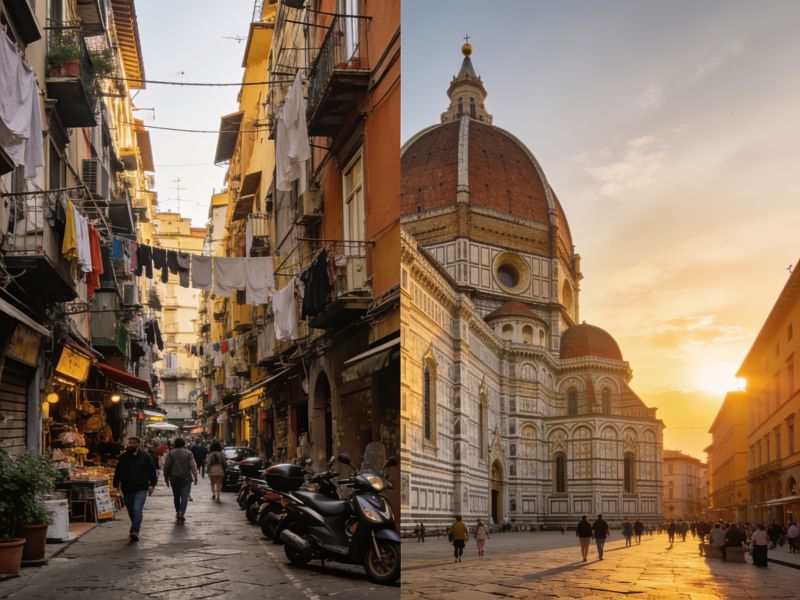
Napoli and Florence sit barely 300 miles apart, yet they feel like different countries. I noticed this on a recent train ride: the moment the Frecciarossa pulled out of Firenze Santa Maria Novella, the Tuscan orderliness gave way to Campanian chaos. Napoli greets you with laundry strung across alleys and Vespas weaving through traffic;Florence welcomes you with groomed piazzas and museum queues. Both cities claim UNESCO World Heritage status for their historic centers。but they wear it differently. In Napoli, the centro storico is a living, breathing maze where baroque churches share walls with fried-pizza stalls. In Florence, the centro storico is an open-air museum where every corner has a plaque. That contrast is the point: Napoli and Florence are not rivals but complements, two halves of the Italian experience.
Art lovers flock to Florence for the Uffizi and the Accademia, and rightly so. But Napoli holds its own. The Museo Archeologico Nazionale houses the Farnese Collection and treasures from Pompeii and Herculaneum—frescoes, mosaics, and the Toro Farnese, a colossal sculpture that dwarfs anything in the Uffizi’s corridors. Florence gave the world the Renaissance;Napoli gave it Caravaggio’s Seven Works of Mercy in Pio Monte della Misericordia。a painting so raw it feels like a gut punch. I spent twenty minutes in front of it, watching light slice through the darkness. In Florence, you admire genius from a distance;in Napoli, art grabs you by the collar. That difference in presentation matters. Florence curates;Napoli confronts.Food tells the same story. Napoli invented pizza as we know it—the margherita at L’Antica Pizzeria Da Michele, with its blistered crust and pools of mozzarella, is a religious experience. Florence counters with ribollita, a thick bread soup that tastes like a peasant’s hug, and bistecca alla fiorentina, a T-bone priced by the kilo. I once ordered a steak in Florence and the waiter weighed it tableside, then grilled it over olive wood. In Napoli。the pizza maker never asked my name;
he just slid a pie onto the counter and nodded. Both meals cost less than a museum ticket, and both teach you more about the city than any guidebook. Food in Napoli is fast and loud;in Florence, it’s slow and deliberate. Choose your mood.Getting around reveals deeper truths. Florence is walkable in a day—from Santa Croce to the Duomo to Ponte Vecchio, all within twenty minutes. Napoli sprawls. The metro’s Line 1 is an art gallery itself, with stations designed by contemporary artists, but the city’s real transport is the funicular up to Vomero or the ferry to Capri. I took the Circumvesuviana train to Herculaneum, and the ride felt like a time warp: graffiti-covered cars, vendors hawking socks, a man playing accordion. Florence’s buses are clean and quiet;
Napoli’s are a social club on wheels. Neither is better—they just demand different travel styles. In Florence。you plan;in Napoli, you improvise. The city rewards those who surrender to its rhythm.Nightfall splits them again. Florence turns into a candlelit stage: floodlit statues, hushed couples on the Arno, a glass of Chianti at a enoteca. Napoli erupts. Spaccanapoli fills with families, students。and street musicians;the air smells of frying dough and sea salt. I watched a group of teenagers play cards on a church step while a nearby barista pulled espresso for a policeman. No one seemed in a hurry. Florence at night feels curated;Napoli at night feels alive. If you have time for only one, pick based on your appetite: Florence for beauty, Napoli for truth. But the honest traveler does both—and realizes that Napoli and Florence together explain Italy better than either alone.